
Quick Summary
| Foundry grinding commonly involves gate and riser removal, casting cleanup, weld dressing, scale removal, edge finishing, and surface correction.
A heavy duty grinder is suited to sustained grinding where material resistance and stock removal are significant. Wheel diameter, free speed, tool weight and air-hose capacity should be considered together rather than in isolation. APT’s Heavy Duty Grinder range includes the AG-100, AG-150 and AG-180, supporting wheel sizes of 100, 150 and 180 mm respectively. APT specifies 6 kg/cm² (85 psi) as the recommended air pressure for its Heavy Duty Grinder range. A vertical air grinder can be preferable where the work requires controlled downward pressure on large or relatively flat surfaces. The air system must be capable of supplying the selected grinder at the required pressure and through an appropriately sized hose. Wheel compatibility, guarding, mounting and operating speed must always be checked before grinding begins. |
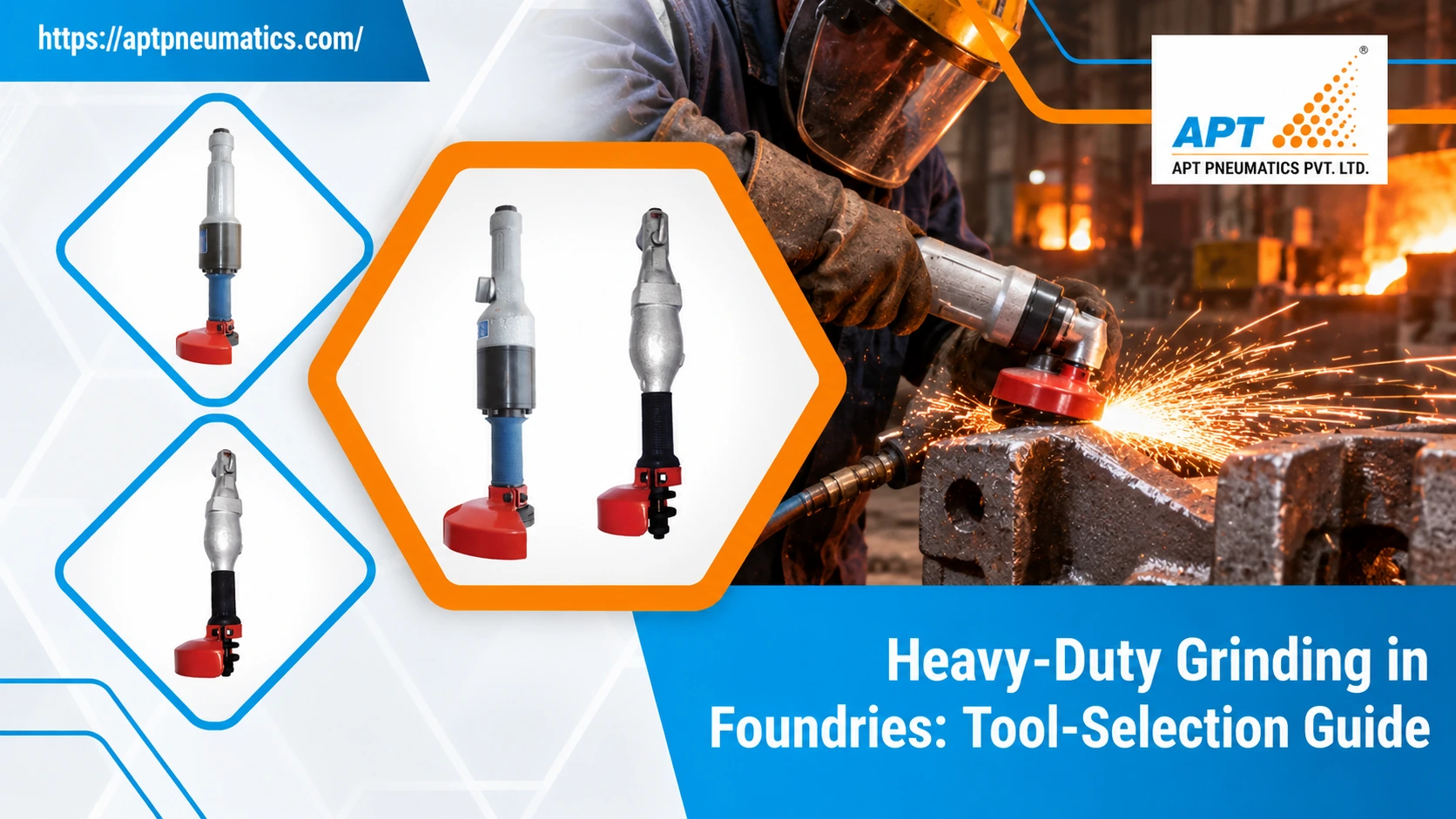
Heavy-Duty Grinding in Foundries: Tool-Selection Guide
Foundry grinding is rarely a light finishing operation. Castings can leave the mould with gates, risers, flash, parting-line irregularities, surface scale and other excess material that must be removed before inspection, machining, coating or dispatch.
The challenge is not simply finding an industrial grinder with sufficient RPM. Foundry grinding can involve high material resistance, large castings, extended operating cycles and awkward working positions. Tool weight, wheel diameter, torque, air supply, operator access, and the direction of applied force can all affect productivity and control.
For these conditions, a heavy duty grinder is often a more appropriate choice than a general-purpose air grinder. However, the right configuration depends on the grinding task. Large castings and demanding material-removal operations may call for greater wheel capacity and a grinder suited to sustained work under load. Flat or floor-mounted work may also favour a vertical configuration.
This guide explains the engineering factors that should be considered when selecting a heavy-duty grinder for foundry grinding and how APT Pneumatics’ range can be matched to different applications.
Why Foundry Grinding Places Higher Demands on the Tool
The grinding stage in a foundry can involve considerably more resistance than conventional light metal finishing.
After casting, excess material may need to be removed from gates and risers, while uneven areas or surface defects may require blending and levelling. Large castings can also make the job physically demanding because the operator may need to work across broad surfaces or reach into difficult positions.
This makes the relationship between the workpiece and the grinder particularly important.
A tool intended for light deburring may have adequate speed but insufficient suitability for sustained high-load grinding. A heavy duty grinder with a larger wheel may be more suitable for demanding material-removal applications. Selection should also account for the grinding load, workpiece geometry, and tool handling.
The objective is therefore to match the grinder to the load profile of the operation, rather than selecting a tool simply because it has a high free speed.
What Grinding Tasks Are Common in Foundries
The first step in selecting an air grinder is to define exactly what needs to be removed and how much material must be taken away. Typical foundry applications include:
Gate and riser removal
Gates and risers can leave substantial sections of excess metal attached to a casting. Removing them can require aggressive grinding and sustained contact between the abrasive wheel and the casting.
A grinder used for this work needs sufficient wheel capacity and stable power delivery under load.
Casting surface correction
Cast surfaces may contain irregularities that need to be levelled before subsequent machining or finishing. The amount of material removed is usually greater than in fine deburring, making a robust heavy duty grinder more suitable for the operation.
Flash and parting-line cleanup
Flash around mould parting lines can create sharp or uneven areas. Depending on the size and geometry of the casting, the operator may require either a general grinding configuration or a more compact tool for localised correction.
Edge finishing and bevel preparation
Edges may need to be dressed or bevelled before another manufacturing process. Here, control becomes just as important as grinding power because excessive material removal can alter the intended geometry.
Scale and surface residue removal
Foundry components may require removal of scale or other surface material before inspection, machining or coating. A pneumatic grinder can provide the continuous rotary action required for this type of surface treatment.
How to Select a Heavy Duty Grinder for Foundry Work
There are several specifications that matter when evaluating a heavy duty grinder.
1. Wheel diameter
Wheel diameter is a useful starting point because it indicates the scale of grinding work the tool is designed to handle.
APT’s Heavy Duty Grinder range covers 100 mm, 150 mm, and 180 mm wheel capacities across the AG-100, AG-150, and AG-180 models. The choice depends on the required grinding coverage, application, operating speed, and handling conditions. Wheel diameter alone does not determine material-removal performance.
For large castings or operations where substantial stock needs to be removed, a larger wheel can provide a more appropriate grinding platform. However, wheel size should always be considered alongside the grinder’s speed, weight, and the specific abrasive being used.
2. Free speed
Free speed should be matched to the wheel and grinding application rather than treated as a measure of grinding capability on its own.
APT’s Heavy Duty Grinder range operates at 6,000 to 9,000 RPM. The AG-100 is rated at 9,000 RPM, while the AG-150 and AG-180 are rated at 6,000 RPM.
Free speed should be considered alongside wheel diameter, the abrasive wheel’s rated operating speed, and the demands of the application. A higher RPM does not automatically mean greater grinding capability. The wheel must be rated for the grinder’s operating speed, and the selected tool must be suitable for the grinding load.
3. Tool weight and operator control
Tool weight becomes increasingly relevant as grinder size increases. APT’s Heavy Duty Grinder models range from approximately 2.45 kg for the AG-100 to 6.50 kg for the AG-180. A larger, heavier tool can be appropriate for demanding grinding, but it also places greater physical demands on the operator.
This makes tool selection partly an ergonomic decision. If grinding involves prolonged handling, awkward access, or work above shoulder height, the largest available grinder may not be the most practical option. The tool should provide sufficient grinding capacity without creating unnecessary handling difficulty.
4. Air supply
The grinder also needs an air system capable of maintaining the required pressure during operation. APT specifies 6 kg/cm² (85 psi) recommended air pressure for its Heavy Duty Grinder range. Hose requirements vary between models, from 9.5 mm on the AG-100 to 19.0 mm on the AG-180.
The air system must maintain adequate pressure at the grinder during operation. Hose length, fittings, couplings, and other restrictions can cause pressure losses, while simultaneous use of multiple pneumatic tools can affect the available air supply. Check the complete installation against the selected model’s requirements rather than relying on compressor pressure alone.
When a Vertical Air Grinder Makes More Sense
Not every foundry grinding task is best handled with a conventional heavy duty grinder. When grinding involves large, relatively flat surfaces or requires sustained downward force, a vertical air grinder can provide a more suitable configuration.
APT’s Vertical Air Grinders are designed for downward grinding on large, flat surfaces and are suited to applications such as surface levelling, scale removal, coarse grinding, and casting cleanup. The heavier models are particularly relevant to demanding applications:
| Model | Wheel size | Free speed | Weight | Air hose |
| ASG-175 | 180 mm (D.C.) | 6,000 RPM | 5.90 kg | 12.7 mm |
| ASG-225HD | 225 mm (D.C.) | 6,000 RPM | 6.20 kg | 12.7 mm |
Both models are specified at 6 kg/cm² (85 psi) recommended air pressure.
The key distinction is configuration. A vertical air grinder is particularly useful when the operator can apply force downwards onto the workpiece. This can make it appropriate for large castings, flat surfaces and work carried out on floor-mounted components.
For a foundry handling several types of castings, the question is therefore not simply whether a heavy duty grinder is required. The more useful question is whether the grinding position favours a conventional or vertical configuration.
Air Supply: Maintaining Grinder Performance
Air delivery depends on the compressor, hose dimensions, fittings and airline layout. Restrictions can reduce the pressure and airflow available at the tool, particularly when several pneumatic tools operate simultaneously.
For an industrial grinder, the air distribution system should be sized to meet the selected model’s requirements under working conditions. Following APT’s specified hose dimensions and checking for pressure losses helps maintain reliable grinder performance.
Grinding Wheel Compatibility and Safe Operation
The abrasive wheel must be suitable for the grinder, the material being worked and the intended operation. Check that its dimensions, mounting arrangement, and maximum rated operating speed are compatible with the tool. Never exceed the wheel’s rated speed.
Use the specified guard and inspect the wheel and mounting components before operation. Damaged wheels or unsuitable components should be taken out of service. Follow the grinder manufacturer’s instructions and applicable workplace safety requirements.
Which APT Grinder Fits the Foundry Application?
The appropriate APT configuration depends primarily on the grinding task and workpiece.
The AG-100 accommodates a 100 mm wheel, while the AG-150 and AG-180 support 150 mm and 180 mm wheels respectively. The appropriate model depends on the required grinding coverage, operating speed, workpiece geometry, and handling conditions.
Where the work involves broad surfaces or sustained downward pressure, the ASG-175 and ASG-225HD Vertical Air Grinders provide a different configuration for heavy-duty grinding.
For more localised finishing, deburring or weld cleanup, APT’s Straight Die Grinders can be considered where the larger wheel capacity of a heavy-duty grinder is unnecessary.
The selection should therefore start with the material-removal task, casting geometry and working position, then be narrowed down by the required grinder capacity and air-system capability.
FAQs
1. What is a heavy duty grinder used for in a foundry?
A heavy duty grinder can be used for demanding foundry operations such as gate and riser removal, casting surface correction, flash cleanup, scale removal, and other material-removal applications.
2. What should be considered when selecting a heavy duty grinder?
Key factors include the amount of material to be removed, wheel diameter, free speed, tool weight, workpiece geometry, operator access, and the compressed-air system supporting the tool.
3. When is a vertical air grinder better than a conventional grinder?
A vertical air grinder can be advantageous when grinding involves large, relatively flat surfaces or sustained downward pressure. It is particularly relevant to applications such as surface levelling, gate removal, and scale cleanup.
4. What air pressure does an APT heavy duty grinder require?
APT specifies 6 kg/cm² (85 psi) as the recommended air pressure for its Heavy Duty Grinder range. The air system must also maintain adequate supply during actual grinding.
5. Is a higher RPM better for heavy-duty grinding?
Not necessarily. Free speed must be considered alongside wheel diameter, wheel rating, and the grinding application. A higher RPM does not automatically mean greater suitability for heavy material removal.
6. Can a die grinder be used for foundry applications?
Yes. A straight die grinder can be used for localised foundry tasks such as deburring, detailed finishing and weld blending, depending on the accessory and application. For larger grinding areas and sustained, high-load material removal, a heavy duty or vertical grinder may be more suitable.