
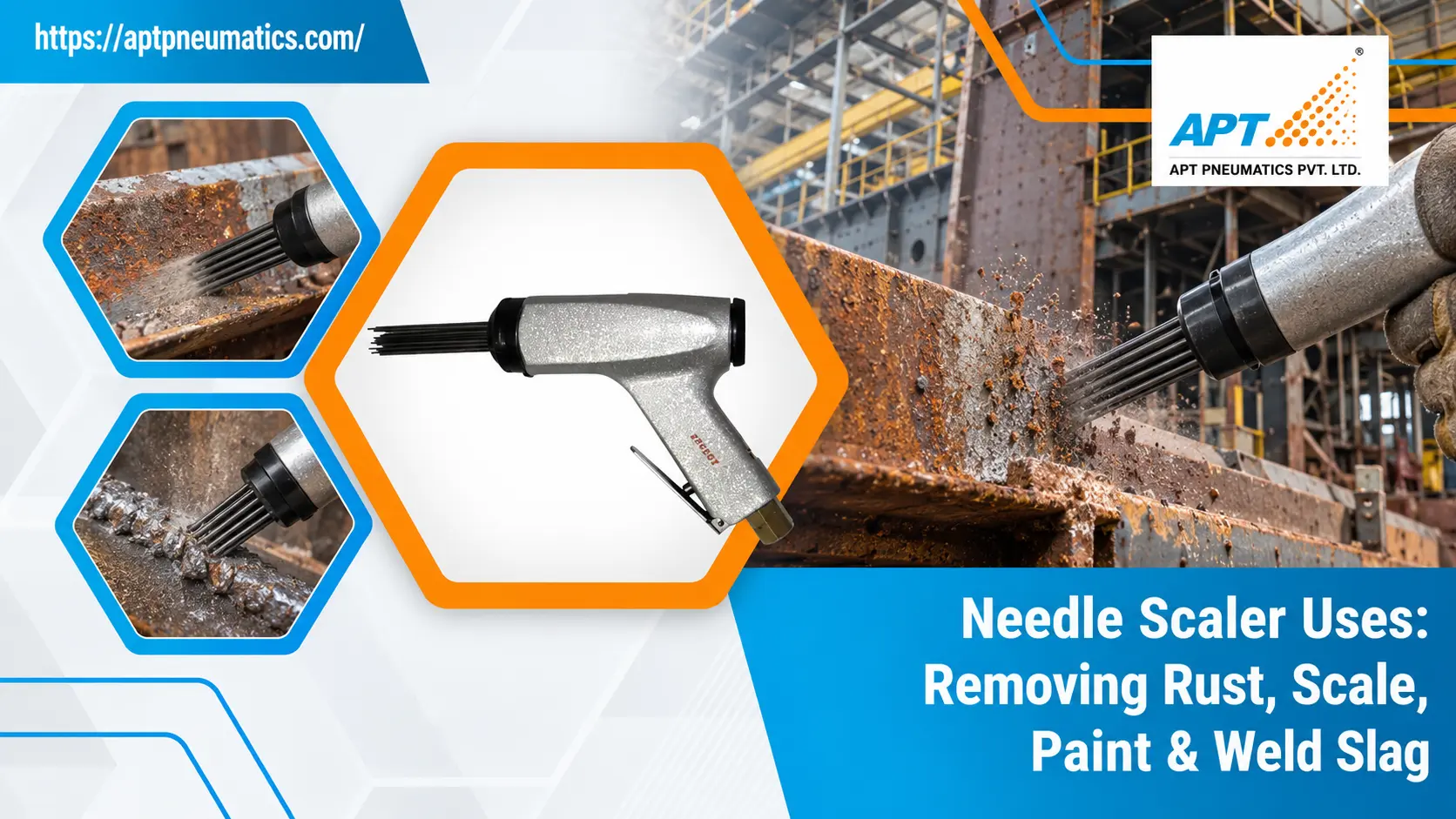
Rust, scale, old paint, and weld slag can build up on metal components during fabrication, service, and maintenance. Removing these layers may be necessary before inspection, repair, welding, or coating, but the job becomes more difficult when contamination is firmly attached or the component has an irregular profile.
For these conditions, surface preparation requires more than simply applying an abrasive to the metal. The removal method needs to suit both the type of contamination and the geometry of the workpiece. A needle scaler is one pneumatic solution used for this type of mechanical surface cleaning.
What Is a Needle Scaler Used For
A needle scaler is a pneumatic tool used to remove stubborn surface material from metal. It operates with multiple steel needles that reciprocate rapidly against the workpiece, delivering repeated mechanical impacts.
Unlike a grinding wheel or sanding belt, the tool does not rely on a broad rotating abrasive surface. The individual needles strike the contaminated area and loosen material attached to the substrate. This makes needle scalers useful for maintenance and fabrication tasks where the objective is to remove surface deposits while working across rough or irregular metal profiles.
What Can a Needle Scaler Remove from Metal
A needle scaler can be used for several types of firmly attached surface contamination.
Rust: Repeated impact helps break up accumulated corrosion products, exposing more of the underlying surface for inspection or further preparation. The condition of the metal should still be assessed after cleaning, particularly where corrosion has caused pitting.
Scale: Hard scale can develop on metal exposed to elevated temperatures or certain manufacturing and service conditions. Needle impact helps fracture and loosen these deposits so they can be removed from the surface.
Old paint and coatings: The impact from the needles can break and lift aged or poorly adhered coatings, helping expose the surface before inspection or recoating.
Weld slag: Hardened welding residue can remain around fabricated joints and weld areas. A needle scaler can break away this residue, including where the profile is irregular.
How effectively a needle scaler removes a deposit depends on factors such as its thickness, adhesion, and the condition of the underlying metal. It should therefore be regarded as a mechanical surface-preparation tool rather than a universal replacement for every metal-removal process.
Why Is a Needle Scaler Useful on Uneven Metal Surfaces
The geometry of a component can make a significant difference to the choice of cleaning tool.
A conventional abrasive wheel or belt generally needs suitable contact with the workpiece to remove material effectively. Maintaining that contact can be difficult around welds, corners, flanges, brackets and curved sections.
A needle scaler approaches these surfaces through multiple narrow needle tips rather than one continuous abrasive surface. The needle bundle can therefore work across changes in profile, while the tool itself can be positioned around difficult areas.
This makes needle scaling particularly useful for rough, contoured, and fabricated metal surfaces where access and surface geometry are important considerations.
How Does a Pneumatic Needle Scaler Work
The operating principle is based on reciprocating impact.
Compressed air powers the tool’s internal mechanism, causing the steel needles to move rapidly back and forth. Each needle repeatedly contacts the workpiece, producing a series of small impacts across the affected area.
These impacts help break the bond between the unwanted surface layer and the metal underneath. Because the tool uses multiple needles rather than a single cutting or grinding point, the impact is distributed across the working area.
APT’s ANS-29 uses a needle arrangement intended to provide uniform power distribution across the needle tips. APT also specifies a design without a spring mechanism, which it states supports smoother operation and reliable needle movement.
The result is a tool suited to removing adhered surface contamination while following the profile of the component.
What Air Supply Does a Pneumatic Needle Scaler Need?
The performance of a pneumatic needle scaler depends on more than simply connecting it to a compressor. The air supply needs to provide the operating pressure specified for the tool, with suitable hose and connection dimensions.
For the APT ANS-29, the specified requirements are:
APT recommends operating the ANS-29 at 6 kg/cm² (85 psi) and keeping the needles lightly lubricated to help prevent jamming and maintain even impact on irregular surfaces.
| Specification | ANS-29 |
| Recommended air pressure | 6 kg/cm² (85 psi) |
| Air hose size | 12.7 mm |
| Air inlet thread | 3/8″ BSP |
| Weight with needles | 1.7 kg |
| Overall length with needles | 300 mm |
The hose diameter and air connection should also be matched to the tool and pneumatic installation. An unsuitable or poorly configured air supply can affect the pressure available at the tool, so the scaler should be considered as part of the complete compressed-air system.
Which APT Needle Scaler Is Suitable for Rust, Scale, Paint and Weld Slag?
APT’s ANS-29 Needle Scaler is specifically intended for surface treatment involving corrosion, slag and old paint on rough and irregular metal surfaces. Its 1.7 kg weight and 300 mm overall length are relevant when the tool needs to be handled around fabricated components or used in areas with restricted access.
The 3/8″ BSP air inlet, 12.7 mm hose requirement and 6 kg/cm² (85 psi) recommended pressure define the pneumatic conditions around which the tool should be installed.
APT also specifies low air consumption and a compact construction for the ANS-29, supporting its use for industrial surface preparation where access and operating duration are important considerations.
FAQ’s
1. Can a needle scaler remove heavy rust?
A needle scaler can break down and remove firmly attached rust and corrosion deposits. However, if corrosion has caused deep pitting or significant metal loss, removing the rust does not restore the damaged base material.
2. Can a needle scaler be used on painted metal?
Yes. A needle scaler can be used to break and loosen old paint and other adhered coatings from metal surfaces. The suitability of the resulting surface for repainting depends on the coating system and the required level of surface preparation.
3. Is a needle scaler suitable for weld cleaning?
Yes. Needle scalers can remove weld slag and residue from fabricated metal components. Their multiple needle tips are particularly useful around irregular weld profiles and other areas where surface geometry makes access more difficult.
4. Does a needle scaler require lubrication?
APT recommends keeping the needles lightly lubricated when operating the ANS-29. This helps prevent jamming and supports even impact on irregular surfaces.
5. What air pressure does the APT ANS-29 Needle Scaler require?
APT specifies a recommended operating pressure of 6 kg/cm² (85 psi) for the ANS-29. The tool also uses a 3/8″ BSP air inlet and a 12.7 mm air hose.