
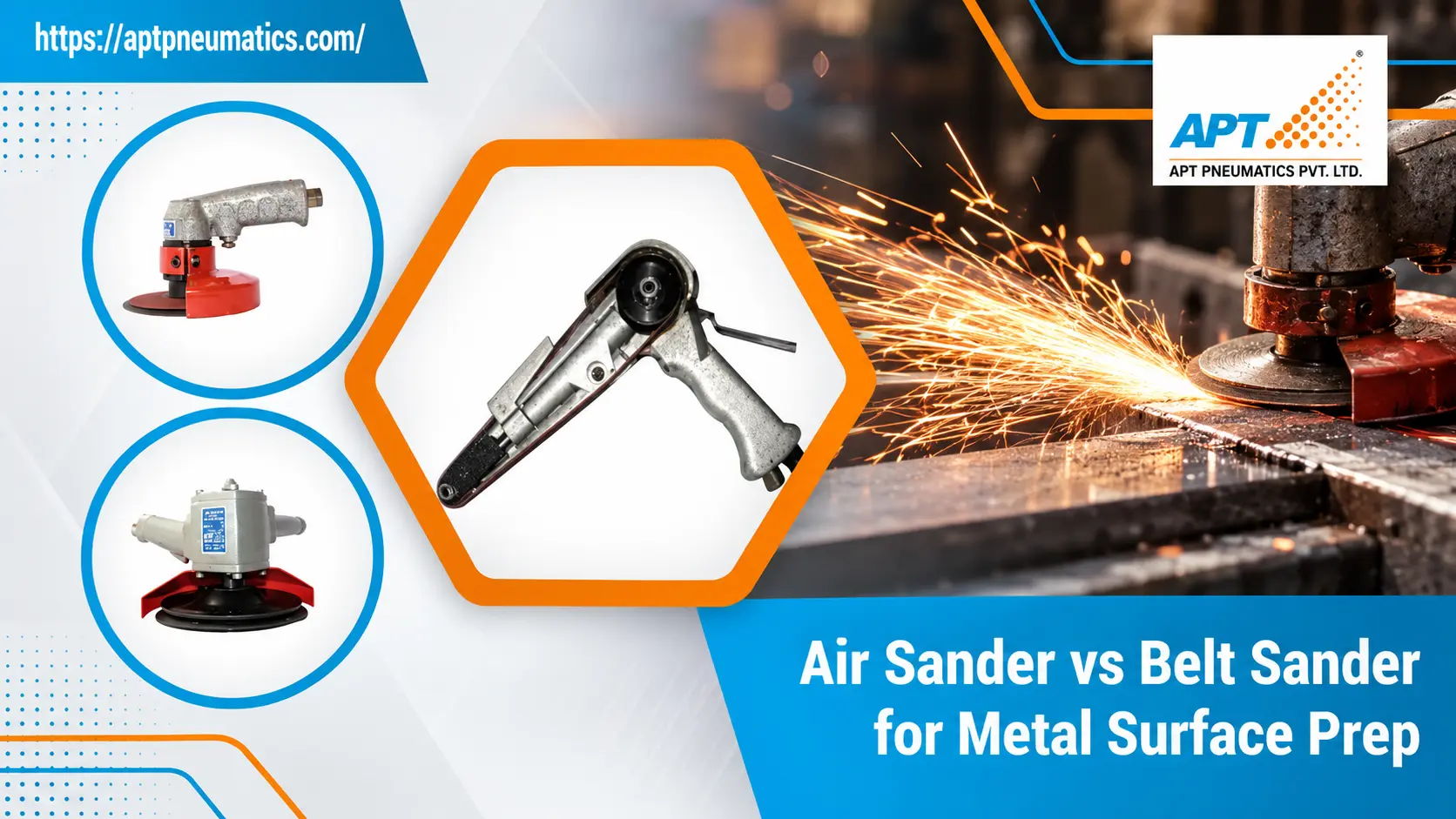
Metal surface preparation can involve treating oxidation, smoothing welds, refining edges, or preparing a component before painting and coating. The right pneumatic sander depends on the area being worked, the surface condition, the required finish, and the access available.
The main difference between an air sander and a belt sander machine for metal is how the abrasive contacts the workpiece. Air sanders generally provide broader abrasive contact for accessible surfaces, while belt sanders use a narrow continuous abrasive belt for more localised work on edges, seams, and restricted sections.
Air Sander vs Belt Sander: What Sets Them Apart
An air sander uses a sanding paper or disc to abrade the workpiece. Its broader contact area makes it suitable for general surface preparation and finishing across accessible metal surfaces.
A belt sander uses a continuous abrasive belt. The narrower abrasive area concentrates the sanding action, making it useful for edges, weld seams, and smaller or restricted sections.
| Application requirement | Air Sander | Belt Sander |
| Broad surface preparation | ✓ | |
| Sheet metal finishing | ✓ | |
| Rust and oxidation removal | ✓ | ✓ |
| Weld seam blending | ✓ | ✓ |
| Edge finishing | ✓ | |
| Confined areas | ✓ | |
| Localised surface finishing | ✓ |
The selection should therefore be based on component geometry, access, and the required surface condition.
Air Sander for Broad Metal Surfaces and General Finishing
An air sander is generally better when the work involves larger, accessible surfaces or requires consistent abrasion across an area.
Air sanders are designed for continuous-duty surface preparation on metal surfaces, welded joints, and cast parts. Applications include deburring, oxidation removal, and pre-coating surface treatment.
APT’s AS-125 and AS-150 provide two different sanding capacities.
The AS-125 accepts 125 mm sanding paper and has a free speed of 14,000 RPM. It weighs approximately 1.20 kg and uses a 1/4-inch BSP air inlet with a 9.5 mm hose.
Its compact, high-speed configuration is suited to surface preparation and finishing where controlled sanding action is required.
The AS-150 is specified for 180 mm sanding paper and operates at 6,000 RPM. It weighs approximately 2.60 kg and also uses a 1/4-inch BSP air inlet and 9.5 mm hose.
Its larger sanding capacity makes it suitable where greater surface coverage is required.
Using a Belt Sander Machine for Metal Edges and Weld Seam Finishing
A belt sander machine for metal is more suitable when sanding needs to be concentrated on a narrow section or when access is restricted.
The continuous abrasive belt can be positioned along edges, seams, and irregular sections where a conventional sanding disc may be less convenient. This makes belt sanding particularly relevant to localised finishing and surface correction.
APT’s ABS-20 Belt Sander is designed for specialised light-duty surface finishing and light material removal, with a compact configuration for limited-area applications.
Its 520 × 20 mm, 120-grit belt and 16,000 RPM free speed provide a narrow, high-speed sanding configuration. The tool is approximately 405 mm long and weighs 1.50 kg.
The narrow belt is particularly useful where the abrasive needs to reach a specific section without working across a much larger surface.
Matching Abrasive Grit to the Surface Condition
The abrasive grit used with an air sander or belt sander machine for metal affects the sanding action and the surface condition achieved. Grit selection should therefore be based on the condition of the metal and the required finish, rather than treated as a fixed specification of the sanding tool.
For metal surface preparation, coarser abrasives are generally used for heavier surface preparation, oxidation, surface imperfections, or weld marks. Finer abrasives are used when the surface has already been prepared and needs further smoothing or refinement.
A practical guide is:
- Coarse grit: heavier oxidation, surface imperfections, and faster material removal
- Medium grit: general metal surface preparation and smoothing
- Fine grit: surface refinement and final finishing
The required grit can also depend on the material being processed, the condition of the surface, and the finish required for the next operation. For example, a surface being prepared for coating may require a different abrasive progression from one being finished for appearance or dimensional correction.
Compressed-Air Requirements for Air Sander and Belt Sander
Air supply is an important consideration when selecting a pneumatic sander.
APT specifies a recommended operating pressure of 6 kg/cm² (85 psi) for the AS-125, AS-150, and ABS-20. All three models specify a 9.5 mm air hose and a 1/4-inch BSP air inlet.
The compressed-air system should be capable of maintaining the required pressure and airflow at the tool. Restrictions in the air line or an unsuitable hose can affect pneumatic tool performance.
Before installation, check:
- Operating pressure
- Hose size
- Available airflow
- Condition of the compressed-air system
Industrial Uses of Air and Belt Sanders in Metalworking
Air sanders and belt sanders are used across a range of industrial metalworking environments where surface preparation, finishing and localised material removal are required. Their applications span manufacturing, fabrication, maintenance and component rework.
Application area:
| Automotive | Metal Fabrication |
| Heavy Engineering | Shipbuilding |
| Railway and Transit Maintenance | Equipment Maintenance and MRO |
The sanding requirements can vary considerably between industries, depending on the component geometry, surface condition, accessibility, and required finish. These factors ultimately determine whether a broader sanding action or a more concentrated belt-sanding approach is appropriate.
Selecting the Right APT Sander for Metal Surface Prep
APT’s pneumatic sanding range covers different stages of metal surface preparation.
The AS-125 is suited to applications requiring a compact, high-speed sanding tool, while the AS-150 provides a larger 180 mm sanding capacity for applications where greater surface coverage is required.
For more concentrated finishing work, the ABS-20 Belt Sander uses a 20 mm wide abrasive belt, making it suitable for edges, weld seams and restricted sections.
The appropriate model ultimately depends on the workpiece, sanding area and required surface finish. Reviewing these factors alongside the tool’s sanding capacity, speed and pneumatic requirements helps identify the most suitable configuration.
Explore APT Pneumatics’ Air Sander and Belt Sander ranges for metal surface preparation and finishing applications.
FAQs
1. Is an air sander or belt sander better for metal surface preparation?
An air sander is generally better for broader, accessible metal surfaces, while a belt sander is more suitable for focused work such as edge finishing, weld seam blending and restricted areas.
2. What is a belt sander machine for metal used for?
A belt sander machine for metal is used for localised surface finishing, edge finishing, weld seam blending and surface correction where a narrow abrasive belt provides better access and control.
3. Which APT sander is suitable for larger metal surfaces?
The APT AS-150 Air Sander uses 180 mm sanding paper, making it suitable for applications where greater sanding coverage is required. The AS-125, with its 125 mm sanding paper and 14,000 RPM free speed, provides a more compact configuration.
4. What abrasive grit should be used for metal surface preparation?
The appropriate grit depends on the condition of the metal and the required finish. Coarser grits are generally used for heavier surface preparation, while finer grits are used for surface refinement. The APT ABS-20 is supplied with a 120-grit belt.
5. What air pressure do APT pneumatic sanders require?
APT specifies a recommended operating pressure of 6 kg/cm² (85 psi) for the AS-125, AS-150 and ABS-20.
6. What hose size is required for APT Air Sanders and the ABS-20?
The AS-125, AS-150 and ABS-20 specify a 9.5 mm air hose and a 1/4-inch BSP air inlet.