
Quick Summary:
A pneumatic sander helps refine metal surfaces before painting by reducing sanding marks and addressing minor imperfections. APT’s Air Sanders, the AS-125 and AS-150, accommodate different sanding paper sizes, while the ABS-20 Belt Sander is suited to applications requiring a narrow abrasive belt. Selecting the right tool depends on the component geometry, surface condition, coating requirements and available compressed-air supply.
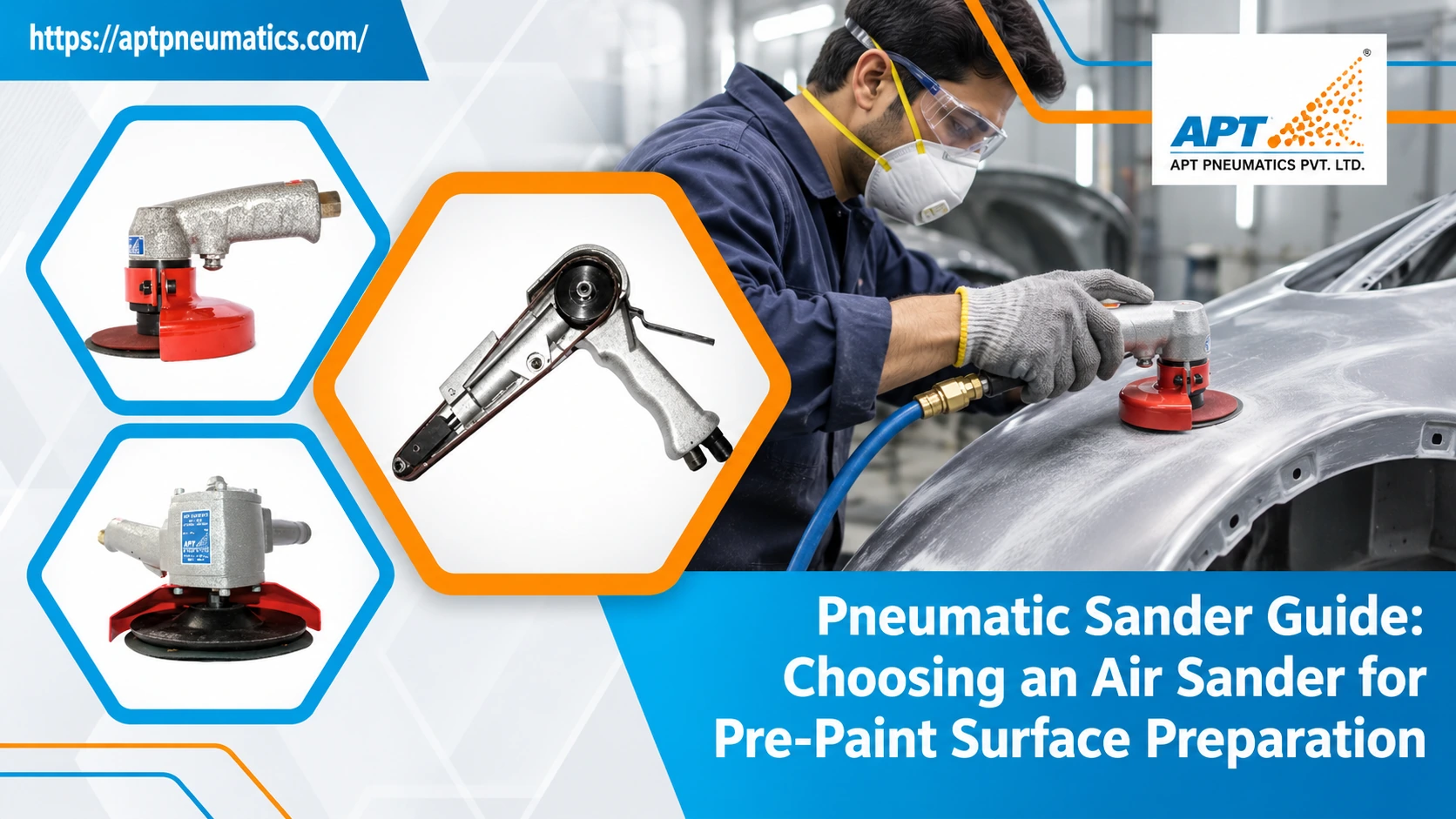
Pneumatic Sander Guide: Choosing an Air Sander for Pre-Paint Surface Preparation
Applying the specified torque is important, but the order and method of tightening also influence how a multi-bolt joint seats and how clamping load is distributed.
A pneumatic sander uses compressed air to power an abrasive pad or belt, helping prepare the metal for the next stage. The choice of abrasive, tool configuration and working method influences the result, making it important to match the equipment to the component rather than use the same approach for every surface.
Air Sander vs. Belt Sander
The main difference between an air sander and a belt sander lies in the abrasive format and the area it can reach conveniently. APT lists its AS-125 and AS-150 under its Air Sanders range, while the ABS-20 is listed separately as a Belt Sander.
Air Sanders accommodate sanding paper in different sizes, making them suitable for a range of surface-preparation tasks. A belt sander uses a continuous abrasive belt that can be positioned along narrow sections, edges and seams.
The distinction helps manufacturers plan how to prepare different areas of a component. For a more detailed comparison of these formats, read Air Sander vs. Belt Sander for Metal Surface Prep.
Where Sanding Fits in Pre-Paint Surface Preparation
Sanding typically follows heavier defect removal and precedes final cleaning and coating. The exact sequence depends on the substrate, the condition of the metal and the coating manufacturer’s requirements.
A typical sequence may involve:
| Weld slag and flux removal → Heavy scale and weld irregularity removal → Sanding and surface refinement → Surface cleaning → Primer and paint application |
This sequence also helps determine which tools are needed at each stage. For example, the APT AC-42 Weld Flux Chipper is intended for removing weld flux and related deposits, while a grinder may be used for heavier material removal. A sander is then selected for the remaining finishing requirements.
APT Air Sanders: Choosing Between the AS-125 and AS-150
APT’s Air Sanders range includes the AS-125 and AS-150. Both use compressed air and accommodate sanding paper, but their specifications differ in abrasive size, free speed and weight.
AS-125 Air Sander
The AS-125 accommodates 125 mm sanding paper and has a free speed of 14,000 RPM. Weighing 1.20 kg, it offers a smaller sanding format for applications where positioning the tool around detailed components is important.
Its suitability depends on the available working area, the abrasive selected and the surface condition. For smaller components or restricted sections, the operator should assess whether the sanding pad can reach the intended area without affecting adjoining edges.
AS-150 Air Sander
The AS-150 accommodates 180 mm sanding paper and has a free speed of 6,000 RPM. Its larger sanding format provides a broader contact area, making it worth considering for accessible surfaces that require wider coverage.
The larger pad also needs adequate clearance around corners, edges and changes in surface profile. Component geometry should therefore guide the choice between the AS-125 and AS-150, rather than relying on speed or abrasive size alone.
APT lists both models for industrial surface-preparation applications. View the specifications on the official APT Air Sanders product page.
When an Air Sander May Not Be Suitable
Although an air sander can be useful on accessible surfaces, its effectiveness depends on how well the abrasive contacts the workpiece.
Uneven weld areas, internal corners and narrow channels can be difficult to prepare with a broad sanding pad. The abrasive may reach raised sections more readily than recessed areas, whil e awkward positioning can lead to inconsistent contact around edges.
Three considerations help address these limitations:
- Heavier defects: Use a suitable grinder, chipper or scaler before sanding when the defect requires substantial material removal.
- Restricted access: Assess whether a smaller sanding format can reach the intended area without affecting adjacent surfaces.
- Narrow sections: Consider a belt sander when the preparation task requires a long, narrow contact area.
The objective is to select equipment according to the defect and the geometry of the workpiece. This helps avoid using a finishing tool for operations better suited to material-removal equipment.
Belt Sander: Working Along Seams and Edges
A belt sander uses a continuous abrasive belt that travels around a narrow arm. This configuration concentrates sanding action along a smaller area, making it useful for applications involving edges, seams and restricted sections.
APT’s ABS-20 Belt Sander uses a 520 × 20 mm belt supplied at 120 grit and has a free speed of 16,000 RPM. Its narrow belt format makes it an option for localised finishing and light material removal, subject to the requirements of the application.
The trade-off is the width of the working area. A narrow belt covers less surface in each pass than a larger sanding disc, so broad panels may require more time to prepare. Manufacturers handling both large surfaces and detailed weld areas can evaluate the two tool formats for different stages of the same operation.
Comparing APT Air Sanders and Belt Sander
| Tool | Working Area | Free Speed | Weight |
| APT AS-125 Air Sander | 125 mm | 14,000 RPM | 1.20 kg |
| APT AS-150 Air Sander | 180 mm | 6,000 RPM | 2.60 kg |
| APT ABS-20 Belt Sander | 520 x 20 mm belt | 16,000 RPM | 1.50 kg |
The specifications provide a starting point for comparing the tools. The final selection should also account for the abrasive required, the component’s shape, the surface condition and the preparation standard.
How to Choose the Right Pneumatic Sander
Once the application and available tool formats are understood, the following checks help narrow the selection.
1. Review the coating specification
The coating manufacturer’s technical data sheet should guide the required surface condition and preparation method. Where applicable, ISO 8501-1 defines visual preparation grades for steel, including St 2 and St 3 for hand or power-tool cleaning. These grades should not be treated as universal sanding requirements for every coating system. Refer to the ISO 8501-1 standard for its scope.
2. Assess the component geometry
Consider the size of the surface, its curvature and the access available around welds, edges and corners. A larger sanding format may suit an accessible panel, while a smaller format or belt may be more practical for restricted areas.
3. Match the abrasive to the task
The appropriate grit depends on the initial surface condition and the finish required. Coarser abrasives generally remove material more aggressively, while finer abrasives are commonly used for refinement. Establish the abrasive sequence through the relevant process specification and representative trials.
4. Check the compressed-air supply
APT specifies a recommended pressure of 6 kg/cm² (85 psi) for the AS-125, AS-150 and ABS-20. Each model also specifies a 9.5 mm air hose and a 1/4-inch BSP air inlet. Check that the installation can provide adequate pressure and airflow at the tool, and follow the manufacturer’s guidance for air quality and maintenance.
5. Evaluate operator handling
Tool weight and access influence handling during repetitive work. Assess the tool on representative components and consider the duration of use, working position and ability to maintain consistent contact throughout the operation.
Supporting the Surface-Preparation Process with APT
APT Pneumatics offers tools for different stages of industrial surface preparation, including the AC-42 Weld Flux Chipper, ANS-29 Needle Scaler, grinders, AS-125 and AS-150 Air Sanders, and ABS-20 Belt Sander.
These tools serve different purposes within the preparation sequence. Chippers and needle scalers address suitable deposits and surface contamination, grinders support heavier material removal, and sanders refine surfaces where required. The combination depends on the component and the specified preparation process.
Manufacturers can explore the APT Air Sanders range and ABS-20 Belt Sander to review available configurations.
Frequently Asked Questions
1. What is a pneumatic sander used for before painting?
A pneumatic sander helps refine metal surfaces by reducing sanding marks and addressing minor imperfections. The required preparation depends on the substrate and coating specification.
2. What is the difference between an Air Sander and a Belt Sander?
APT’s Air Sanders use sanding paper in specified sizes, while the ABS-20 uses a continuous 20 mm-wide abrasive belt. The choice depends on the working area, access and preparation requirements.
3. Which APT Air Sander is suitable for larger surfaces?
The AS-150 accommodates 180 mm sanding paper, providing a larger sanding format than the AS-125, which accommodates 125 mm sanding paper. Suitability depends on the component and available access.
4. What grit should be used for metal surface preparation?
The correct grit depends on the existing surface condition and the finish required. Coarser abrasives generally remove material more aggressively, while finer abrasives support surface refinement.
5. What air pressure do APT Air Sanders require?
APT specifies a recommended operating pressure of 6 kg/cm² (85 psi) for the AS-125, AS-150 and ABS-20. Adequate airflow at the tool is also important.
6. Can a belt sander replace an Air Sander?
Not in every application. A belt sander is useful for localised work along narrow sections, while an Air Sander may be more practical for broader, accessible surfaces. Some production processes may benefit from both formats.