
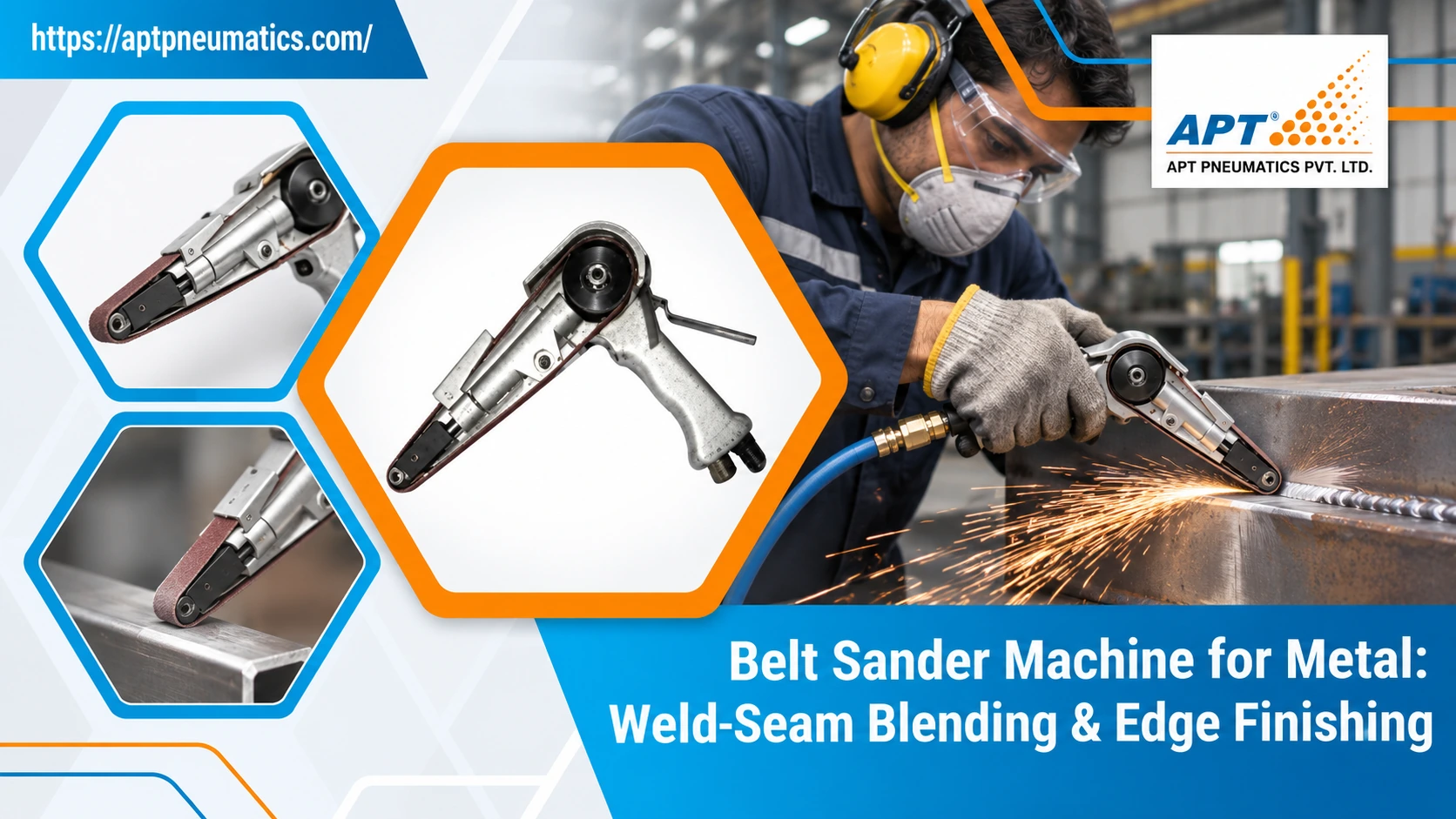
Quick Summary:
A belt sander machine is used in metal fabrication for weld-seam blending, burr removal and edge finishing. Its continuous abrasive belt enables controlled material removal along welded joints, narrow sections and restricted work areas. In industries such as automotive manufacturing, shipbuilding and stainless steel equipment fabrication, these operations help achieve the required surface condition before assembly, coating or further processing. Selecting the right belt sander machine for metal involves evaluating abrasive grit, belt width, operating speed and workpiece geometry. APT Pneumatics’ ABS-20 offers a pneumatic solution for specialised, light-duty metal-finishing applications.
Belt Sander Machine for Metal: Weld-Seam Blending & Edge Finishing
The work on a welded component doesn’t end when the welding is complete.
Welded joints may retain raised beads, uneven transitions and excess material that need attention before components move to assembly, coating or inspection. Similarly, cutting and machining operations can leave burrs and sharp edges. These finishing requirements are common across metal fabrication, where achieving the specified surface condition without compromising component geometry is an important part of the production process.
The challenge is to remove unwanted material while maintaining parent material thickness, component geometry and the specified weld profile. This makes post-weld finishing and edge preparation important considerations in manufacturing quality.
How Does a Belt Sander Machine Support Weld-Seam Blending?
Weld-seam blending involves refining the transition between a welded joint and the surrounding parent material. For light-duty finishing applications, this may involve correcting localised surface irregularities or blending accessible weld sections. Substantial weld-reinforcement removal requires appropriately specified grinding equipment and must follow the applicable weld profile and engineering requirements.
Shipbuilding provides a practical example. Fabricated components such as handrails, pipe supports, brackets and structural sections involve welded connections that may require post-weld surface treatment. Some of these assemblies have confined working areas where a compact belt sander can support localised surface correction and light-duty weld-seam blending.
A belt sander machine uses a continuous abrasive belt that moves around rotating rollers. The abrasive grains contact the workpiece and progressively remove material through abrasion, helping refine the surface profile.
A belt sander machine for metal is particularly useful for:
- Weld-seam blending: Refining accessible weld sections through light-duty blending and localised surface correction.
- Bracket fabrication: Smoothing localised areas around welded connections.
- Structural components: Addressing surface irregularities along selected sections.
- Restricted working areas: Accessing narrow sections where wider abrasive tools may be difficult to position.
The material removal process must follow the specified weld profile and inspection requirements. Excessive grinding can reduce parent material thickness and compromise the intended joint geometry.
What to Consider When Selecting an Industrial Belt Sander
Selecting an industrial belt sander requires evaluating workpiece geometry, material properties and finishing requirements. The following parameters influence tool suitability:
| Selection parameter | Engineering relevance |
| Belt width | Determines the abrasive contact area and accessibility along narrow sections. |
| Abrasive grit | Influences material removal and achievable surface finish. |
| Free speed | Indicates the abrasive belt’s operating speed without load. |
| Tool weight | Affects handling, positioning and operator control. |
| Air pressure | Ensures the pneumatic tool operates at the specified pressure. |
For pneumatic applications, compressed-air supply capacity, hose dimensions and air inlet compatibility should also be evaluated. Maintaining the manufacturer’s recommended operating conditions is important for consistent tool performance.
APT Pneumatics ABS-20: Designed for Specialised Belt Sanding Applications
For fabrication workshops and industrial maintenance operations requiring localised surface finishing, APT Pneumatics offers the ABS-20 Belt Sander.
Designed for specialised light-duty finishing and material-removal applications, the ABS-20 features a compact configuration suited to limited-area finishing requirements.
Its key specifications include:
- Abrasive belt size: 520 × 20 mm
- Abrasive grit: 120
- Free speed: 16,000 RPM
- Overall length: Approximately 405 mm
- Tool weight: Approximately 1.5 kg
- Air inlet: 1/4-inch BSP
- Air hose size: 9.5 mm
- Recommended air pressure: 85 PSI
The 20 mm belt width supports focused sanding applications, while its compact design makes it easier to position around smaller finishing areas.
Its lightweight construction also supports handling across different component orientations.
For fabrication bays, foundries, shipyards and railway workshops, the ABS-20 provides a pneumatic option for specialised light-duty surface correction, weld-seam blending and edge-finishing requirements.
As with any pneumatic finishing tool, the recommended air pressure, suitable abrasive and application-specific operating practices should be followed to maintain consistent results.
Explore the APT Pneumatics ABS-20 Belt Sander for detailed product specifications and application information.
Choosing the Right Pneumatic Sander for Metal Finishing
Not every surface-finishing requirement calls for the same abrasive configuration. A wider air sander may be more suitable for accessible surfaces requiring broader abrasive contact, whereas a belt sander is useful for focused material removal along narrow edges, welded sections and restricted profiles.
The selection should be based on component geometry, required material removal and final surface specifications. Understanding these differences helps production teams match the equipment to the operation rather than relying on a single tool for multiple finishing requirements.
For a detailed comparison, read Air Sander vs Belt Sander for Metal Surface Preparation.
Conclusion
Weld-seam blending and edge finishing are important operations in preparing fabricated metal components for subsequent manufacturing processes. Achieving the required surface condition involves selecting suitable abrasive equipment, controlling material removal and maintaining the component’s specified geometry.
With its narrow 20 mm abrasive belt, compact construction and pneumatic operation, the APT Pneumatics ABS-20 offers a specialised solution for light-duty metal-finishing applications across fabrication and industrial maintenance environments.
Frequently Asked Questions
1. What is a belt sander machine used for in metal fabrication?
A belt sander machine is used for weld-seam blending, burr removal, edge finishing and localised surface correction. It uses a continuous abrasive belt to remove unwanted material and refine metal surfaces.
2. Can a belt sander machine for metal be used on welded joints?
Yes. A belt sander can be used for light-duty blending of accessible weld sections and correction of localised surface irregularities. Substantial weld-reinforcement removal requires suitable grinding equipment. All material removal must comply with the required weld profile and inspection standards.
3. What is the difference between an air belt sander and an electric belt sander?
An air belt sander uses compressed air to drive its motor, whereas an electric belt sander operates using electrical power. Selection depends on the application, available infrastructure and operating requirements.
4. Which abrasive grit is suitable for metal edge finishing?
Grit selection depends on the material grade, initial surface condition and required finish. Coarser abrasives are generally used for more aggressive material removal, while finer abrasives support surface refinement.
5. Which industries use industrial belt sanders?
Industrial belt sanders are used in metal fabrication, automotive manufacturing, shipbuilding, railway workshops, foundries and heavy engineering for weld cleanup, edge preparation and surface finishing.
6. What are the specifications of the APT Pneumatics ABS-20 Belt Sander?
The ABS-20 features a 520 × 20 mm, 120-grit abrasive belt, a free speed of 16,000 RPM and a tool weight of approximately 1.5 kg. It has a recommended operating air pressure of 85 PSI and is designed for specialised light-duty finishing applications.