
Quick Summary
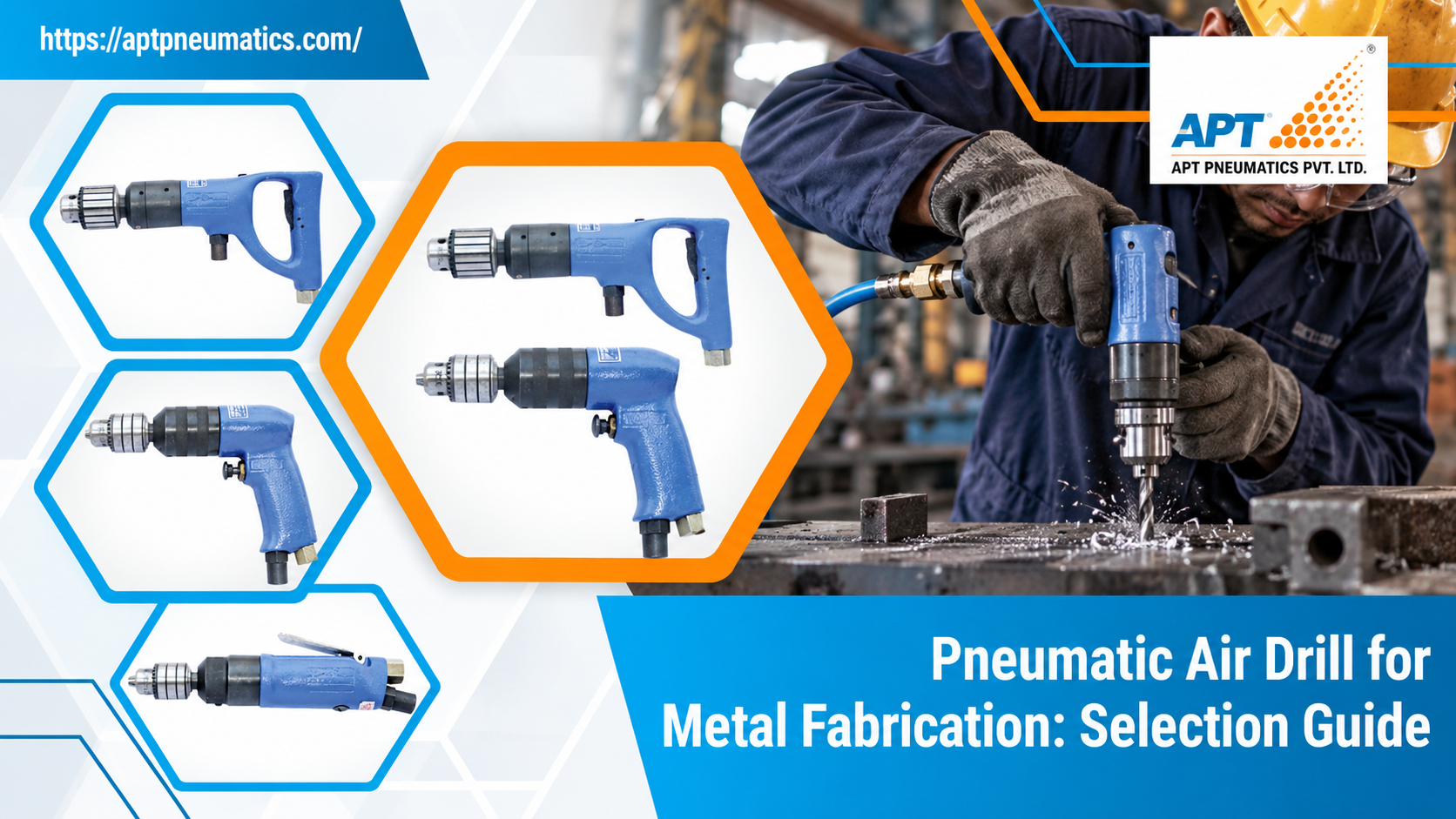
Selecting the right Pneumatic Air Drill for metal fabrication depends on drilling capacity, rotational speed, workpiece material, compressed-air supply and tool ergonomics. Smaller drill bits generally require higher speeds, while larger diameters operate at lower speeds. APT Pneumatics offers Air Drills with drilling capacities of 6 mm, 10 mm and 13 mm, operating at free speeds between 1,200 and 3,000 RPM. Matching these specifications to the application helps fabrication teams achieve controlled drilling and efficient tool operation.
Pneumatic Air Drill for Metal Fabrication: Selection Guide
Metal fabrication involves drilling holes in sheet metal, brackets, frames, structural components and fabricated assemblies. Consistent drilling helps achieve accurate fitment, reliable assembly and a clean finished component. For workshops handling regular drilling operations, selecting the right Pneumatic Air Drill requires consideration of more than drilling speed.
Material type, hole diameter, compressed-air supply, tool dimensions, operator handling and production requirements all influence the selection. A pneumatic drill uses compressed air to rotate its spindle and cutting tool, making it a practical solution for fabrication environments with an established pneumatic system.
This guide covers the key factors to consider when choosing an Air Drill for metal fabrication, along with APT Pneumatics’ available models.
What Is a Pneumatic Air Drill
A Pneumatic Air Drill is a rotary drilling tool powered by compressed air. Instead of an electric motor, the tool uses an air motor to rotate the spindle and drill chuck.
Pneumatic drills are particularly useful in industrial workshops where compressed air already powers grinders, sanders, scalers and other equipment. This allows drilling to become part of an integrated pneumatic workflow.
APT Pneumatics offers Air Drills designed for metalworking, fabrication and assembly applications. Its range features sensitive trigger control, a silenced mechanism and a dual-bearing spindle arrangement for controlled industrial operation.
Why Use an Air Drill for Metal Fabrication
Fabrication processes often require repeated holes for fasteners, mounting points, brackets, fixtures and assembly connections. A pneumatic Air Drill can offer several practical advantages:
- Compact construction for easier handling
- Sensitive trigger control for controlled drilling
- Different capacities for varying hole sizes
- Compatibility with compressed-air systems
- Lightweight options for repetitive work
- Integration with other pneumatic workshop equipment
The correct model depends on the application. Hole diameter, material, workspace and production requirements should all be considered before selecting a tool.
Key Factors When Selecting a Pneumatic Air Drill
1. Drilling Capacity
Start by identifying the largest hole diameter required for the application. Selecting an appropriate capacity ensures compatibility with the drill bits used during production.
APT Pneumatics offers models with 6 mm, 10 mm and 13 mm drilling capacities. Smaller-capacity models suit lighter drilling applications, while higher-capacity configurations accommodate larger holes.
Use the listed drilling capacity as the starting point for model selection. The workpiece material, thickness, drill-bit type and operating conditions should also be considered when determining whether a model is suitable for a particular job.
2. Free Speed
Free speed refers to spindle rotation in RPM without load. The appropriate speed depends on the drill-bit diameter, workpiece material and cutting conditions.
aller drill bits can generally operate at higher rotational speeds than larger bits, but the appropriate speed also depends on the workpiece material, drill-bit specifications and cutting conditions.
APT’s range covers free speeds from 1,200 to 3,000 RPM, giving fabrication teams options for different drilling applications. Always consider RPM alongside drill-bit specifications and material requirements.
3. Material Being Drilled
Different metals have different machining characteristics. Mild steel, stainless steel, aluminium and other alloys can require different drilling conditions. Before selecting an Air Drill, consider:
- Workpiece material
- Material thickness
- Required hole diameter
- Hole depth
- Drill-bit type
- Production volume
The air drill supplies the rotary motion, while the drill bit and operating parameters determine the cutting performance.
4. Compressed Air Supply
A pneumatic tool depends on an appropriate compressed-air system for consistent operation.
APT Pneumatics recommends 6 kg/cm² (85 psi) for its Air Drill range. The models use a 1/4-inch B.S.P. air inlet and a 9.5 mm air hose.
The compressed-air system should maintain suitable pressure and airflow at the drill during operation. Check hose diameter, fittings, line condition and pressure losses to ensure the tool receives the required air supply.
Use a suitable filter-regulator-lubricator (FRL) arrangement in accordance with APT’s operating and maintenance instructions. The air supply should be clean and regulated, with lubrication provided as specified by the manufacturer.
5. Tool Weight and Ergonomics
Fabrication operators can perform numerous drilling cycles during a shift, making tool weight and balance important.
APT’s range includes lightweight models as well as a higher-capacity configuration. The tool should be comfortable to hold and control according to the working position and drilling frequency.
For repetitive applications, consider the number of holes per component and the frequency with which the operator needs to reposition the tool.
6. Overall Length and Access
Frames, enclosed structures and closely positioned components can restrict access to drilling points. Overall tool length therefore becomes an important selection factor.
APT provides standard and extended configurations. The AD-6SR and AD-10SR offer longer overall lengths than their standard counterparts, providing additional reach for suitable applications.
Consider the available space around the workpiece and the required reach before choosing between standard and extended configurations.
APT Pneumatic Air Drill Model Comparison
| Model | Drilling Capacity | Free Speed | Weight with Chuck | Overall Length | Air Inlet | Hose Size |
| AD-6 | 6 mm | 3.000 RPM | 1.10 kg | 178 mm | ¼’ B.S.P. | 9.5 mm |
| AD-6SR | 6 mm | 2,900 RPM | 1.10 kg | 245 mm | ¼’ B.S.P. | 9.5 mm |
| AD-10 | 10 mm | 2,200 RPM | 1.25 kg | 188 mm | ¼’ B.S.P. | 9.5 mm |
| AD-10SR | 10 mm | 2,200 RPM | 1.25 kg | 250 mm | ¼’ B.S.P. | 9.5 mm |
| AD-13 | 13 mm | 1,200 RPM | 2.30 kg | 300 mm | ¼’ B.S.P. | 9.5 mm |
The range uses a recommended air pressure of 6 kg/cm² (85 psi).
Choosing an Air Drill for Different Fabrication Applications
The ideal configuration depends on the nature of the work.
| Application | More actionable guidance |
| Smaller holes | Consider AD-6 or AD-6SR for applications within their 6 mm listed capacity. |
| General fabrication | Consider AD-10 or AD-10SR where the required drilling capacity is up to 10 mm. |
| Larger holes | Consider AD-13 for applications requiring the range’s highest listed capacity of 13 mm. |
| Restricted access | Compare the overall lengths of standard and extended models against the available clearance. |
| Repetitive drilling | Assess capacity, tool weight, operator position and air-supply capability together. |
Pneumatic Air Drill vs Electric Drill
Pneumatic and electric drills use different power sources, so the workshop environment should guide the decision.
A Pneumatic Air Drill is particularly suitable for facilities that already use compressed air for multiple tools. A single pneumatic infrastructure can support drilling, grinding, sanding and surface preparation operations.
Electric drills can suit locations where compressed air is unavailable or electrical portability is preferred. For workshops with established pneumatic systems, air-powered drilling can integrate naturally into existing operations.
Supporting Pneumatic Tools for Metal Fabrication
Drilling is often one stage of the fabrication process. Other pneumatic tools can support preparation and finishing.
A die grinder can assist with deburring, edge preparation and detailed material removal. Air sanders can support surface preparation, while belt sanders are useful for localised finishing and weld-seam work. Needle scalers can help remove rust, scale, paint and weld slag from suitable metal surfaces.
Using complementary pneumatic equipment can help create an efficient workflow from drilling through to finishing.
Best Practices for Pneumatic Air Drill Performance
Good tool selection should be supported by correct operation and maintenance.
- Select drill bits according to material and hole diameter.
- Maintain the recommended operating pressure.
- Use the specified hose size and suitable fittings.
- Keep compressed air clean and properly regulated.
- Use an appropriate FRL arrangement.
- Apply feed pressure suitable for the material and drill diameter.
- Inspect the chuck and spindle regularly.
- Check pneumatic connections during maintenance.
- Choose a tool configuration suited to the workspace.
- Follow the manufacturer’s operating instructions.
Why Choose APT Pneumatics?
APT Pneumatics has manufactured pneumatic tools in India since 1988 and develops solutions for industrial applications. Its Air Drill range provides configurations covering 6 mm, 10 mm and 13 mm drilling capacities, giving fabrication teams options for different hole sizes and access requirements.
APT Pneumatics offers multiple Air Drill models for industrial drilling applications, allowing fabrication teams to select equipment according to their specific requirements.
For workshops, the right Air Drill combines suitable drilling capacity with controlled operation, practical ergonomics and compatibility with the existing compressed-air system.
Frequently Asked Questions
1. What is a Pneumatic Air Drill used for?
A Pneumatic Air Drill is used to create holes in metal components, sheet metal, brackets, frames and fabricated assemblies. It is suitable for fabrication, assembly and industrial maintenance applications.
2. Which APT Air Drill is suitable for smaller holes?
The AD-6 and AD-6SR provide a maximum drilling capacity of 6 mm, making them suitable for smaller-diameter drilling applications.
3. Which APT model has the highest drilling capacity?
The AD-13 has the highest drilling capacity in the range, supporting holes up to 13 mm.
4. What air pressure does an APT Air Drill require?
APT Pneumatics recommends 6 kg/cm² (85 psi) for its Air Drill range.
5. What is the difference between the AD-10 and AD-10SR?
Both models have a 10 mm drilling capacity and 2,200 RPM free speed. The AD-10SR has a longer overall length, providing additional reach for suitable applications.
6. How should a Pneumatic Air Drill be maintained?
Maintain the recommended air pressure, use clean and regulated compressed air, inspect air connections and tool components regularly, and follow the manufacturer’s maintenance instructions.