
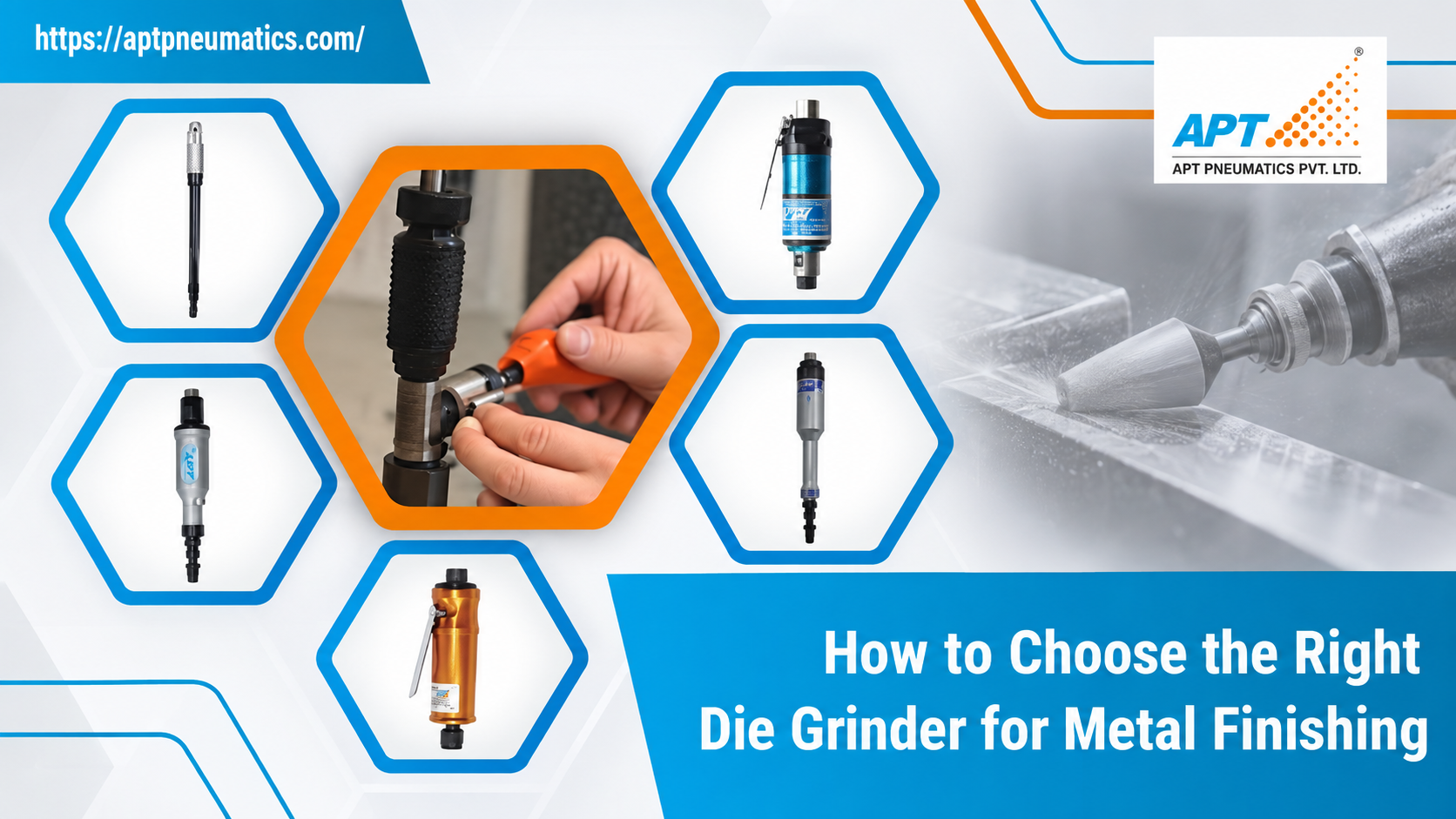
Metal-finishing work can involve anything from weld cleanup and deburring to material removal, chamfering and detailed finishing. Each application places different demands on the tool, which is why choosing the right die grinder involves more than comparing maximum RPM.
For anyone evaluating a die grinder machine, the important questions are practical: What type of work will it perform? How much access does the operator have? What speed and accessory are required? Can the existing air system support the tool? And is the grinder intended for occasional work or regular industrial use?
The right choice comes from matching these factors to the application rather than simply selecting the highest specification available.
What to Consider When Choosing a Die Grinder
The first step in selecting a die grinder is to understand the work it needs to perform most often. Common applications include:
| Cleaning castings | Removing weld irregularities |
| Chamfering | Material removal |
| Blending and finishing welds | Fine grinding in restricted areas |
| Deburring edges and components | |
APT’s Straight Die Grinders are direct-drive pneumatic tools designed for applications including material removal, weld cleanup, chamfering and deburring. The range includes different speed and body-length configurations, allowing the tool to be selected according to the working requirements.
For more intricate applications, a micro die grinder can be more appropriate. APT’s Micro Die Grinder is designed for high-speed deburring, fine finishing and light grinding in confined or intricate areas. This distinction matters because the best die grinder machine for general grinding is not necessarily the best option for detailed work.
Straight Die Grinder vs Micro Die Grinder
Configuration should be based on the size of the workpiece, accessibility and the amount of material that needs to be removed.
A straight die grinder is a versatile option for many general industrial grinding tasks. APT’s straight range includes models from 14,500 to 35,000 RPM, with different body lengths and configurations. Depending on the model, the range supports applications involving mounted points and abrasive wheels. A straight configuration can be useful for:
| Weld seam cleaning | Surface correction |
| Chamfering | Deburring |
| Grinding castings | Part preparation |
| Work requiring additional reach | |
A micro die grinder, by comparison, is intended for smaller and more detailed operations. APT’s AP-60 operates at 60,000 RPM, has a 3 mm collet, an overall length of approximately 140 mm, and weighs approximately 0.24 kg. Its compact format is intended for detailed deburring, fine edge finishing and light grinding where positioning and access are important.
The choice is therefore not simply between a smaller and larger die grinder. It is about matching the configuration to the physical and finishing requirements of the job.
How to Choose the Right Die Grinder RPM
RPM is an important specification, but a higher number does not automatically mean a better die grinder. The appropriate speed depends on the material, application and accessory. Higher speeds can be useful for detailed deburring and fine finishing, while broader grinding work may require a different balance of speed, material engagement and control.
Accessory selection needs to be considered at the same time. Mounted points, rotary burrs and abrasive wheels have operating limits that should be compatible with the grinder’s speed.
The correct die grinder machine is therefore the one whose operating range matches both the accessory and the work being performed. Rather than choosing the fastest model available, consider the finish required, the amount of material being removed and the accessory being used.
Die Grinder Size, Body Length and Accessibility
The physical dimensions of a die grinder can influence how effectively the operator can position it. A compact tool may be easier to control around smaller components, while an extended configuration can provide useful reach when the working area is recessed or difficult to access directly.
APT’s straight range includes compact models as well as extended configurations, with listed body lengths ranging up to approximately 600 mm. This allows selection based on the geometry of the workpiece and the required reach.
Weight should also be considered alongside the task. A heavier tool may be appropriate for a particular grinding load, while a lighter configuration can be easier to manage during detailed or repetitive work.
Die Grinder Air Requirements and Collet Size
Because a pneumatic die grinder machine depends on a compressed-air system, the supporting setup should be checked before selecting the tool.
APT’s straight die grinder range specifies a recommended working pressure of 6 kg/cm² [85 psi], with a 1/4-inch BSP air inlet. The standard collet chuck size is 6 mm, with 1/4-inch, 1/8-inch, 3 mm and 8 mm options available on request. The AP-60 micro grinder has a 3 mm collet and a 1/4-inch BSP air inlet.
These differences are important when selecting accessories. The collet must correspond with the accessory being used, while the air system should be capable of supporting the tool at its recommended operating conditions.
It is also worth checking compressor capacity, air-line condition, hose arrangement and inlet requirements as part of the purchasing decision.
Die Grinder vs Heavy Duty Grinder vs Air Sander
A die grinder machine is versatile, but it is not the best solution for every metal-finishing application. If the work involves heavier grinding loads, larger surfaces or sustained material removal, a dedicated Heavy Duty Grinder may be more suitable. For surface preparation and sanding rather than focused rotary grinding, an Air Sander may be the better choice.
This comparison helps establish an important selection principle: the right tool category should be determined by the nature and scale of the work.
Choosing the Right Die Grinder Machine From APT Pneumatics
Once the application is defined, selecting an APT die grinder machine becomes a matter of matching the configuration to the job.
| Requirement | Suitable option |
| General grinding and deburring | Straight Die Grinder |
| Weld cleanup and chamfering | Straight Die Grinder |
| Extended or difficult-to-reach areas | Longer straight configuration |
| Fine deburring | Micro Die Grinder |
| Confined or intricate work | Micro Die Grinder |
| Heavy grinding and material removal | Heavy Duty Grinder |
| Surface preparation and sanding | Air Sander |
The final selection should be based on the material, access, accessory, speed, air supply and workload rather than simply choosing the highest RPM or largest tool.
FAQ
1. What is a die grinder used for?
A die grinder is commonly used for deburring, weld cleanup, chamfering, material removal, casting cleanup and finishing. The appropriate configuration depends on the application and required accessory.
2. How do I choose the right RPM for a die grinder machine?
Choose the RPM according to the material, finishing requirement and accessory. Higher speeds can suit detailed deburring and fine finishing, while other grinding applications may require a different balance of speed and control.
3. What is the difference between a straight die grinder and a micro die grinder?
A straight die grinder is suited to broader industrial grinding, deburring, weld cleanup and material-removal work. A micro die grinder is designed for detailed, light grinding and finishing in confined or intricate areas.
4. What collet size does a die grinder use?
Collet size depends on the model. APT’s straight die grinder range uses a 6 mm collet chuck as standard, with other sizes available on request. The AP-60 Micro Die Grinder uses a 3 mm collet.
5. Should I choose a die grinder or a heavy-duty grinder?
For focused grinding, deburring and finishing work, a die grinder machine may be appropriate. For larger surfaces, heavier grinding loads, weld levelling, or sustained material removal, a heavy-duty grinder may be a better fit.