
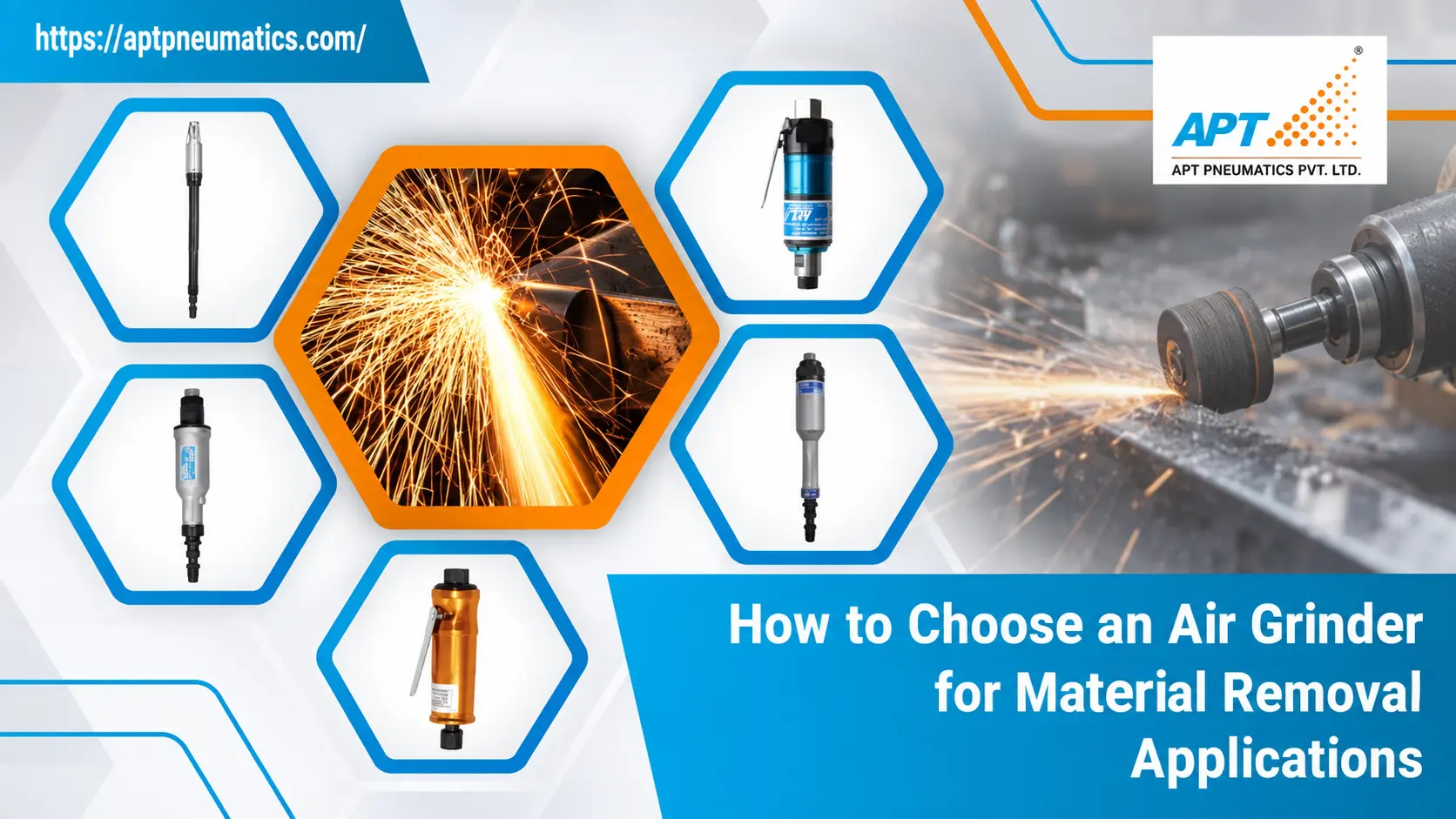
Material removal is one of the most common operations in fabrication, foundries, shipyards, and heavy engineering. But not every air grinder is designed for the same job. Cleaning a casting, removing scale, deburring an edge, and grinding a large steel plate all require different tool configurations.
APT Pneumatics offers a comprehensive range of pneumatic finishing tools for industrial material removal. Its grinder portfolio includes Straight Die Grinders, Heavy Duty Grinders, and Vertical Air Grinders, each designed for specific grinding applications and working conditions.
Choosing the right air grinder starts with understanding the material removal task. The application, workpiece geometry, and grinder configuration matter far more than simply comparing specifications.
How Does an Air Grinder Work?
An air grinder converts compressed air into high-speed rotary motion to remove material using an abrasive wheel, mounted point, or rotary burr. APT’s grinders use powerful multi-vane air motors for continuous industrial grinding. The process is simple:
- Compressed air enters the grinder.
- The air drives the pneumatic motor.
- The spindle rotates the abrasive at high speed.
- The abrasive removes material from the workpiece.
- The operator controls the amount of material removed through tool position and abrasive selection.
The air grinder drives the abrasive, while the abrasive determines the material removal rate and the surface finish.
How Different Grinding Applications Change Tool Selection
The first selection decision is the type of material removal you need to perform.
Straight Die Grinder: Precision
- Best for edge finishing, deburring, casting cleanup, chamfering, and grinding in confined spaces.
Heavy Duty Grinder: High-load
- Designed for aggressive material removal, heavy surface treatment, scale removal, and sustained industrial grinding.
Vertical Air Grinder: Large surfaces
- Ideal for flat surfaces where stability and downward grinding force are important, including foundry and fabrication work.
The right air grinder is selected by matching its configuration to the material removal application, the workpiece, and the grinding load it is designed to handle.
Straight Die Grinder vs Heavy Duty Grinder vs Vertical Air Grinder |
|||
| Feature | Straight Die Grinder | Heavy Duty Grinder | Vertical Air Grinder |
| Primary use | Precision material removal | Heavy material removal | Large surface grinding |
| Wheel capacity | Up to 63 mm | 100–180 mm | 75–225 mm |
| Free speed | 14,500–35,000 RPM | 6,000–9,000 RPM | 6,000–15,000 RPM |
| Best suited for | Deburring, chamfering, cleanup | Scale removal, shaping, castings | Flat plates, foundries, structural work |
Each grinder configuration is engineered around a different balance of wheel capacity, access, stability, and grinding performance, making the application the starting point for selection.
When Should You Choose a Heavy Duty Grinder?
A heavy duty grinder is built for applications where the abrasive remains under continuous load for long periods. Larger grinding wheels, higher tool mass, and a quick-action constant speed governor help maintain cutting speed as resistance changes. Choose a heavy duty grinder when the application involves:
- Scale removal on steel components
- Casting cleanup in foundries
- Material shaping on large metal parts
- Heavy surface treatment
- Continuous production grinding
APT’s heavy duty grinder range includes 100 mm, 150 mm, and 180 mm wheel capacities, allowing different grinding loads to be matched to the application.
Why Wheel Size Matters in an Air Grinder
Wheel diameter changes both the grinding coverage and the type of work an air grinder can perform.
| Wheel size | Typical application |
| Up to 63 mm | Deburring, edge work, confined access |
| 75–100 mm | General surface grinding |
| 150–180 mm | Heavy material removal |
| 225 mm | Large flat surface grinding |
Smaller wheels provide better access around components, while larger wheels improve productivity on broad surfaces. This is why APT offers different air grinder families instead of one universal design.
Which Air Grinder Is Right for Continuous Industrial Use?
If the operation involves repetitive production grinding, durability becomes as important as speed.
APT’s heavy duty grinder range is designed with reinforced construction, larger wheel capacities, and stable handling for extended grinding cycles. Straight Die Grinders prioritise manoeuvrability, while Vertical Air Grinders provide greater stability during downward grinding on large components.
For most heavy fabrication environments, selecting the correct air grinder is less about maximum RPM and more about matching the grinder configuration to the material removal requirement.
FAQs
1. What is an air grinder used for?
An air grinder is used for material removal, including deburring, chamfering, casting cleanup, scale removal, surface preparation, and industrial grinding operations.
2. When should I choose a Heavy Duty Grinder?
Choose a heavy duty grinder for high-load applications such as casting cleanup, heavy surface treatment, material shaping, and continuous grinding on large metal components.
3. What is the difference between a Straight Die Grinder and a Heavy Duty Grinder?
A Straight Die Grinder is designed for precision material removal and access in confined spaces, while a Heavy Duty Grinder is built for larger wheels, sustained grinding, and aggressive material removal.
4. Why are Vertical Air Grinders used on flat surfaces?
A Vertical Air Grinder offers greater stability and leverage during downward grinding, making it suitable for large steel plates, structural components, and foundry applications.
5. How do I select the right air grinder?
Select an air grinder based on the application, material removal requirement, wheel size, workpiece geometry, and grinder configuration. The tool should match the job rather than simply offering the highest speed or largest wheel.